

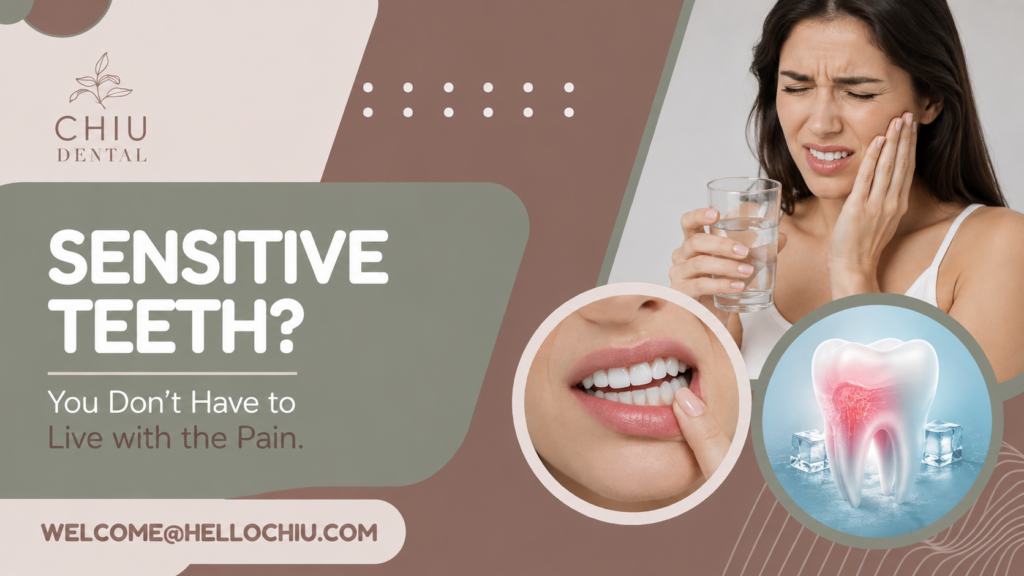
Sensitive Teeth: Why That Jolt of Pain Happens and What Actually Fixes It
Most people have felt it at least once: a sip of cold water, a bite of ice cream, or a rush of cold air, and suddenly a sharp, electric jolt shoots through a tooth. For some people it happens once and never again. For others, it becomes a daily companion that quietly changes what they eat and drink, and how they brush their teeth.
Tooth sensitivity, known clinically as dentin hypersensitivity, is one of the most common complaints in general dentistry, and also one of the most misunderstood. Many people assume it is simply something that comes with age, or that nothing can really be done about it beyond switching toothpaste. Neither of those things is true. Let’s walk through what causes sensitive teeth, why the pain happens the way it does, and what a dentist can actually do to fix the underlying problem rather than just numb the symptom.
How Common Is Tooth Sensitivity, Really?
The honest answer is that estimates vary widely, and the range itself tells you something important about how underreported this condition is. A study published in the Journal of the American Dental Association, which screened 787 adults at general dental practices, found that roughly 12 percent had genuine dentin hypersensitivity once other causes like cavities or gum disease were ruled out. But that same study noted that prior research had reported prevalence anywhere from 1 percent to 52 percent of patients, largely depending on how the question was asked and whether sensitivity was self-reported or clinically confirmed.
Larger population surveys tend to land much higher. A multicentre survey of over 2,400 people in France found that 42.2 percent had experienced sensitive teeth in the previous year. A European study across seven countries involving more than 3,500 adults found that over half of participants showed signs of dentine hypersensitivity, with women more commonly affected than men. Sensitivity was found across every age group, but tended to peak in people in their late thirties through late forties, an age range many people would not associate with new dental problems.
What almost every study agrees on is this: sensitivity is significantly more common in women, more common in people with gum recession, and more common in people who have had at-home teeth whitening. It is also, by a wide margin, one of the most undertreated dental complaints. Some research suggests only about half of people experiencing it are doing anything to actively manage it, often relying on trial and error with drugstore products rather than getting a proper diagnosis.
What Is Actually Happening Inside a Sensitive Tooth?
To understand why sensitive teeth hurt the way they do, it helps to understand the structure of a tooth. The visible, white part of a tooth is covered in enamel, the hardest substance in the human body. Below the gumline, the root is covered by a softer layer called cementum. Underneath both of these protective layers sits dentin, a porous tissue riddled with microscopic tubules that lead directly to the nerve at the center of the tooth.
When enamel or cementum wears away or recedes, dentin becomes exposed. Those microscopic tubules act almost like tiny straws. Hot, cold, sweet, acidic, or even just a rush of air can trigger fluid movement inside those tubules, and that fluid shift is registered by the nerve as a sharp, sudden pain. This is why the sensation is so distinctive: it is fast, sharp, and usually resolves within seconds, unlike the deep, throbbing ache of a cavity or infection.
Several things commonly lead to dentin exposure. Gum recession, whether from periodontal disease, aggressive brushing, or simply aging, exposes the root surface, which has no enamel covering it at all and is far more vulnerable. Enamel erosion from acidic foods and drinks, frequent vomiting, or acid reflux gradually thins the protective outer layer. Tooth grinding and clenching, called bruxism, wears down enamel over time through mechanical force rather than acid. Aggressive brushing with a hard-bristled brush or excessive pressure can wear away both enamel and gum tissue. Recent dental work, including whitening treatments, fillings, or professional cleanings, can cause temporary sensitivity as tissues settle. And cracked teeth or old, worn fillings can expose dentin at a very specific, localized point, which is why sensitivity that is isolated to a single tooth often needs a closer look rather than a change in toothpaste.
Why So Many People Just Live With It
Sensitive teeth rarely announce themselves as an emergency. The pain is brief, it is triggered by predictable things, and it is easy to simply avoid the trigger rather than address the cause. Many people quietly stop drinking anything cold, breathe through pursed lips in cold weather, or chew exclusively on one side of their mouth without ever mentioning it at a dental visit.
This is a problem for two reasons. First, sensitivity is frequently a visible signal of something progressing underneath it, whether that is gum recession, enamel erosion, or a crack that has not yet become a bigger issue. Second, the discomfort genuinely affects quality of life more than people tend to admit, changing everyday choices around food, drink, and even how people brush, sometimes leading them to brush less thoroughly out of fear of pain, which then makes gum health worse and creates more sensitivity. It becomes a cycle that a five-minute conversation at a checkup can usually interrupt.
What a Dentist Actually Checks For
When a patient mentions sensitive teeth, a dentist is not just going to hand over a tube of desensitizing toothpaste and send them on their way. A proper evaluation looks at several things. The pattern of the sensitivity matters a great deal: sensitivity across many teeth usually points toward generalized enamel wear, erosion, or recession, while sensitivity isolated to one tooth often suggests a crack, a failing filling, or in some cases a deeper issue like an early cavity or a tooth that needs a root canal.
The dentist will also look at gum health and recession, checking whether roots are exposed and whether that recession is stable or actively progressing. They will assess enamel wear patterns, which can reveal whether erosion from diet or acid reflux is a factor, or whether grinding is wearing teeth down mechanically. And they will rule out the things that can mimic sensitivity but require very different treatment, including cavities, cracked teeth, and infections, because treating a cracked tooth like ordinary sensitivity delays the real fix and can allow the crack to worsen.
Treatment Options: From the Toothpaste Aisle to the Dental Chair
Not every case of sensitivity needs a procedure. Treatment genuinely depends on the cause and severity, and a good dentist will start with the least invasive option that actually addresses the problem.
Desensitizing toothpaste containing potassium nitrate or stannous fluoride works by gradually blocking the tubules in exposed dentin or calming the nerve’s response to stimuli. It typically takes two to four weeks of consistent use to show real benefit, which is a common reason people give up on it too early and assume it does not work.
In-office fluoride varnish or desensitizing agents applied directly to sensitive areas can provide much faster relief than toothpaste, often within a single visit, by sealing exposed tubules more aggressively than an over-the-counter product can.
Dental bonding can cover an exposed root surface or a small area of eroded enamel with a tooth-colored resin, physically sealing the exposed dentin. This is often used when recession has exposed a specific, localized area.
Gum grafting is considered when recession is significant and progressive. Rather than just masking the exposed dentin, a graft restores gum coverage over the root surface, addressing both the sensitivity and the longer-term risk that untreated recession poses to the tooth’s stability.
A nightguard is the appropriate treatment when grinding or clenching is identified as the underlying cause. Treating the sensitivity without addressing ongoing grinding is treating the symptom while the cause continues to wear teeth down.
A root canal becomes necessary in the smaller number of cases where sensitivity turns out to be a sign of nerve involvement, typically from a deep crack, a failing old filling, or decay that has progressed further than surface-level dentin exposure.
The point of an evaluation is matching the treatment to the actual cause. Reaching straight for the most common over-the-counter fix without knowing which of these categories applies is how people end up managing symptoms for years without resolving what is actually happening.
Signs Your Sensitivity Is Worth a Closer Look
Occasional mild sensitivity, especially after a whitening treatment or a dental cleaning, is common and usually resolves on its own. A few patterns are worth bringing to a dentist’s attention specifically:
- Sensitivity isolated to one tooth, rather than spread across several, particularly if it lingers longer than a few seconds
- Pain that lingers after the hot or cold trigger is gone, rather than resolving quickly, which can point toward nerve involvement
- Sensitivity that is getting worse over weeks or months rather than staying stable
- Visible gum recession or teeth that look longer than they used to
- A history of teeth grinding, morning jaw soreness, or a partner who has mentioned grinding sounds at night
- Sensitivity that started after a specific event, like biting down on something hard, which can indicate a crack
- Pain when biting or chewing, which is a different symptom from temperature sensitivity and often points toward a structural issue rather than exposed dentin
If several of these apply, it is worth an actual exam rather than another few months of a different toothpaste.
What Happens If It Goes Unaddressed
Sensitivity itself is not dangerous, but what causes it often is not something that improves on its own. Gum recession tends to progress rather than reverse without treatment. Enamel erosion is permanent; enamel does not regenerate once it is gone. Grinding that goes unmanaged continues to wear teeth down and can eventually affect the jaw joint. And a crack that is dismissed as ordinary sensitivity can progress to the point where a tooth becomes unsalvageable, turning what might have been a straightforward bonding procedure into a root canal or extraction.
None of this is meant to be alarming. Most causes of sensitivity are very manageable when caught early, and the discomfort itself, while genuinely disruptive to daily life, is rarely a sign of anything urgent. It is simply a reason to get an actual diagnosis rather than continuing to guess.
What to Expect From an Evaluation
A conversation about your symptoms. When the sensitivity started, what triggers it, whether it is isolated to one tooth or widespread, and whether it has changed over time.
A visual and physical exam. Checking for visible recession, enamel wear, cracks, and the condition of any existing fillings.
Diagnostic testing where needed. This can include checking each tooth individually for sensitivity, gentle percussion testing to check for issues below the gumline, and X-rays if a crack, deep decay, or nerve involvement is suspected.
A treatment plan matched to the cause. Whether that means a recommendation to switch toothpaste and reassess in a month, an in-office desensitizing treatment, a bonding procedure, a nightguard, or a referral for a root canal if nerve involvement is found.
Frequently Asked Questions About Sensitive Teeth
Does whitening always cause sensitivity? Not always, but it is a common temporary side effect, especially with stronger whitening concentrations or overuse of at-home kits. It usually resolves within a few days to a couple of weeks. Sensitivity that persists much longer than that is worth mentioning to a dentist.
Is sensitivity toothpaste actually effective, or is it a placebo? It is genuinely effective for many people, but it needs consistent use over several weeks to work, and it will not resolve sensitivity caused by a crack or deep decay. It is a reasonable first step for generalized, mild sensitivity, not a universal fix.
Can sensitive teeth be a sign of a cavity? Yes, in some cases. This is exactly why an evaluation matters rather than assuming every instance of sensitivity has the same cause. A cavity typically causes more localized, sometimes lingering pain, but it can be difficult to tell the difference without an exam.
I only feel it in cold weather, not with food or drink. Is that still worth mentioning? Yes. Sensitivity to cold air is still dentin hypersensitivity and follows the same underlying causes as sensitivity to cold drinks. It is just as worth mentioning at your next visit.
Will my sensitivity ever fully go away? In many cases, yes, once the underlying cause is treated, whether that is a graft, bonding, a nightguard, or simply consistent use of the right toothpaste. In cases involving significant enamel loss, the goal is usually meaningful, lasting reduction rather than a complete return to feeling nothing at all, since enamel itself cannot be regrown.
One thing worth mentioning at your next cleaning
If you have been avoiding cold drinks, chewing on one side, or wincing through your morning coffee, mention it at your next checkup even if it feels minor. A quick look often reveals exactly what is causing it, and most causes are far easier to treat early than after months or years of quietly working around the pain.
Chiu Dental Is Here When You Need Us
Chiu Dental is Kitchener-Waterloo’s friendly dental home, and when it comes to tooth sensitivity, we understand that even a sip of cold water or a bite of your favorite food can cause sudden discomfort. Our goal is to help you feel comfortable, explain the cause of your sensitivity, and provide personalized treatment in a welcoming, judgment-free environment.
The most important step is getting your sensitive teeth evaluated. Tooth sensitivity can be caused by worn enamel, gum recession, cavities, cracked teeth, or other dental concerns. The sooner you know what’s causing the pain, the more treatment options you have. Waiting may allow the problem to worsen.
We are currently accepting new patients at our Waterloo office. If you’re experiencing tooth sensitivity or discomfort when eating, drinking, or brushing, call us today, and we’ll get you in as quickly as possible.
Our office is located at 113-5 Father David Bauer Dr, Waterloo, ON N2L 6M2. Call us at (519) 884-0887 to book your appointment, or schedule online at hellochiu.com. For dental emergencies, reach us at 1-888-757-9361.
After your visit, we would love to hear about your experience. Leaving us a review helps other patients in Kitchener, Waterloo, and Cambridge find compassionate, honest dental care when they need it most.
Chiu Dental. We will take it from here.