

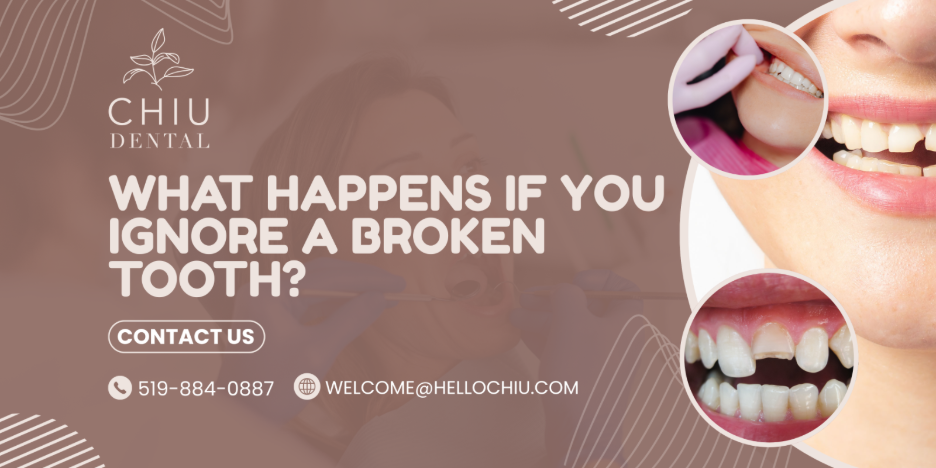
It happens more often than you might think. A tooth chips on a piece of crusty bread. A crack appears after biting into something harder than expected. A chunk breaks away from a tooth that already had a large filling. The immediate reaction for most people is the same: probe it with a tongue, wince, and then decide to deal with it later.
Later has a way of becoming weeks, then months. And in the meantime, a problem that was fixable with a simple procedure quietly becomes something much more complicated.
Here is the truth about what actually happens inside a broken tooth when it goes untreated, why the absence of pain is not the reassurance most people think it is, and what the treatment options look like at each stage of the problem. We want to give you an honest picture, not to alarm you, but because understanding the progression makes the case for acting early far more compelling than any generic reminder to see your dentist.
Not All Broken Teeth Are the Same
Before walking through the consequences of ignoring a broken tooth, it helps to understand that the word broken covers a wide range of situations. The clinical picture and the urgency of treatment vary significantly depending on what type of fracture you are dealing with.
Craze lines are the most minor category. These are hairline cracks in the outer enamel only, extremely common in adult teeth, and they require no treatment at all. They do not penetrate deeper than the enamel surface and cause no structural weakness or pain. If your dentist mentions craze lines at a checkup, they are simply noting something visible, not something that needs fixing.
Fractured cusps occur when a piece of the chewing surface breaks away, often around an existing filling. They are usually not very painful because the fracture tends not to involve the pulp, the innermost layer of the tooth containing nerves and blood vessels. A fractured cusp is a manageable problem when caught and treated promptly, typically with a crown. Left alone, the exposed area becomes an entry point for bacteria and the fracture line can extend further into the tooth.
Cracks extending toward the gum line are where urgency increases significantly. These are fractures that run vertically through the tooth and progress downward. If the crack has not yet reached the gum line, a crown placed promptly can often hold the tooth together and stop further extension. Once the crack extends below the gum line, the tooth’s prognosis changes considerably and extraction may be the only viable option.
Split teeth are the result of a crack that has propagated all the way through the tooth, separating it into two distinct segments. This typically cannot be reversed. Depending on the position of the split, a portion of the tooth may sometimes be saved, but complete tooth loss is frequently the outcome.
Vertical root fractures begin below the gum line and extend upward. They are often asymptomatic for extended periods, which is part of what makes them dangerous. By the time they cause noticeable pain, infection in the surrounding bone and gum tissue has often already developed. They are almost always diagnosed late, and extraction is the most common outcome.
The common thread across nearly all of these categories is the same: the earlier the intervention, the more options remain on the table. Every week and month of delay closes doors that cannot be reopened.
One thing most people do not realize about cracks: unlike a cavity, a crack in a tooth does not stay the same size. Every time you bite down, the crack flexes. Every time you eat something cold, the temperature differential causes the tooth to expand and contract. Every grinding episode at night applies force across the fracture line. A crack that was manageable with a crown today may become unrestorable in three months, not because anything dramatic happened, but because of the cumulative mechanical stress of daily use.
The Silence That Misleads: Why Painless Does Not Mean Safe
This is the part of the story that catches people most off guard, and it is the most clinically important thing to understand about broken and cracked teeth.
Many cracked and broken teeth cause no pain at all, particularly in the early stages. This is not because nothing is happening. It is because the nerve inside the tooth, the pulp, has not yet been directly involved. The outer layers of the tooth, enamel and dentin, do not have the same dense nerve supply as the pulp. A crack can travel through these layers without triggering the kind of pain that signals danger.
Here is the part that is genuinely counterintuitive: when the pain from a cracked or broken tooth disappears, it can actually mean things have gotten worse, not better. When bacteria reach the pulp and the nerve tissue begins to die, the pain that accompanied the infection often subsides temporarily. The nerve is no longer transmitting pain signals because it is no longer functional. Patients sometimes interpret this as the tooth having healed on its own. It has not. The infection has simply progressed to a stage where the nerve tissue is dead, and the bacterial activity continues spreading into the root and surrounding bone in silence.
Research from the National Institute of Dental and Craniofacial Research has confirmed that untreated dental infections spread beyond the tooth and affect surrounding tissues. The quiet period between initial fracture and eventual serious complication is the window when treatment is simplest and least expensive. Once symptoms return after that quiet period, the situation is almost always more complex than it was before.
If you had pain from a broken tooth and it stopped on its own without treatment, please do not assume the problem resolved. Spontaneous pain resolution in a previously symptomatic broken tooth is a common precursor to abscess formation. The infection is still there. It simply progressed past the point where the nerve could register it. Book an appointment and let us take an X-ray.
What Happens Inside the Tooth Over Time
Let us walk through the biological progression that occurs when a broken tooth goes untreated, because understanding the sequence makes the urgency concrete.
Bacteria enter through the fracture. Your mouth contains hundreds of species of bacteria. The moment a crack or chip creates an opening in the protective enamel and dentin, bacteria gain access to the internal structure of the tooth. Bacterial penetration into a fracture begins quickly.
Decay accelerates along the fracture line. Bacteria trapped within a crack produce acids that actively dissolve tooth structure. Unlike the surface of a tooth, which you can clean with a toothbrush and floss, the interior of a fracture is inaccessible to any home care. The decay inside the crack advances without any ability to slow it from the outside.
The pulp becomes inflamed. As bacteria and their byproducts reach closer to the pulp, the tissue inside the tooth responds with inflammation. This stage, called pulpitis, is often when pain or significant sensitivity begins. At this stage, a root canal can still save the tooth. The pulp is inflamed but the surrounding bone and tissue are not yet involved.
The pulp becomes infected and dies. Without treatment, the bacterial infection overwhelms the pulp tissue. The nerve dies. The pain that accompanied pulpitis may subside, creating the false impression of improvement. The infection does not die with the nerve. It continues advancing toward the root tip.
An abscess forms. A dental abscess is a pocket of pus that develops at the root tip as the body’s immune system attempts to contain the bacterial spread. An abscess can form within one to two weeks of initial bacterial invasion of the pulp, though this timeline varies. Signs include facial swelling that extends beyond the tooth, a foul taste in the mouth from pus discharge, and sometimes fever. Lymph nodes near the jaw may become swollen and tender.
The infection spreads. Left untreated, an abscess does not stay contained to the tooth root. The infection can spread to the surrounding jawbone, causing a condition called osteomyelitis. It can spread to the soft tissues of the face and neck. In rare but serious cases, it can progress to Ludwig’s angina, a rapidly spreading infection of the floor of the mouth and neck that can compromise the airway and require emergency medical intervention.
If a dental infection is accompanied by facial swelling that is spreading, difficulty swallowing or breathing, fever above 38.5 degrees Celsius, or a feeling that your throat is tightening, go to the emergency room immediately. These are signs that an infection has spread beyond the tooth into the deeper tissues of the face and neck. This is a medical emergency, not a situation to wait out until a dental appointment becomes available.
What Happens to the Surrounding Teeth and Bone
A broken tooth does not create problems in isolation. The surrounding teeth and supporting structures are affected by what happens in and around it.
When a tooth is cracked or broken and left untreated, the adjacent teeth subtly shift to compensate for changed bite forces. The opposing tooth that used to make contact with the broken one no longer has that contact point, and over time it can begin to drift. This gradual movement affects the alignment of your bite and can create pressure problems in teeth that were previously completely healthy.
The bone that surrounds an infected tooth is also at risk. Persistent infection in the bone causes gradual bone loss in that area. This matters enormously if a dental implant ever becomes necessary to replace the tooth, because an implant requires sufficient healthy bone to anchor into. Bone lost to infection does not always regenerate fully, and replacing it requires bone grafting procedures that add time, complexity, and cost to treatment.
The gum tissue around a chronically infected tooth also suffers. The tissue adjacent to an abscess is typically inflamed, and the pocketing that develops around the affected tooth can sometimes persist even after the tooth is treated or removed, complicating the health of the gum tissue in that area long after the original problem is resolved.
The Cost of Waiting: Treatment Options at Each Stage
Here is one of the clearest arguments for acting early on a broken tooth, and it is a practical one that resonates with every patient we see at our Waterloo office.
Early fracture without pulp involvement: cosmetic bonding or a dental crown. Relatively straightforward, often completed in one to two appointments, and the tooth is preserved intact.
Fracture with pulp inflammation: root canal treatment followed by a crown. More involved than a simple crown but still a reliable tooth-saving procedure with a high long-term success rate. Most patients find it far less uncomfortable than the reputation suggests.
Fracture with abscess: root canal treatment, drainage of the abscess, and a course of antibiotics where indicated, followed by a crown. The infection adds complexity and recovery time but the tooth can often still be saved at this stage if the root structure is intact.
Fracture with bone loss or split below the gum line: extraction. Once the fracture extends below the gum line or significant bone loss has occurred, extraction is often the only option remaining. This then opens the question of how to replace the tooth, whether with a dental implant, a bridge, or a denture, each of which involves additional procedures, appointments, and cost.
The difference between a crown placed on an early fracture and an extraction followed by an implant is not trivial. It is the difference between a single appointment and a process that can span six to twelve months and carry a cost several times higher. Every stage of delay moves patients along that spectrum toward the more complex and expensive end.
What to Do Right Now If You Have a Broken Tooth
Whether you broke a tooth this morning or months ago, here is the practical guidance.
If it just happened: rinse your mouth gently with warm salt water. If there is a visible broken piece, keep it in a small container of milk or saliva and bring it to your appointment. Avoid biting on that side. Take over-the-counter pain relief if needed. Contact our office to book an appointment as soon as possible, ideally within 24 to 48 hours.
If you have sharp edges: dental wax, available at most pharmacies in Kitchener and Waterloo, can be pressed over a sharp edge to protect your tongue and cheek while you wait for your appointment.
If you have had a broken tooth for a while: even if it currently does not hurt, please book an appointment. We will take X-rays to assess what is happening below the surface. The absence of pain does not mean treatment can wait indefinitely, and knowing the current status of the tooth determines what options are still available to you.
If you have facial swelling, fever, or difficulty swallowing: do not wait for a regular dental appointment. Contact our emergency line at 1-888-757-9361 or go to the emergency room. These are signs that an infection has spread beyond the tooth.
Frequently Asked Questions About Broken Teeth
My tooth broke but I have no pain at all. Do I still need to see a dentist? Yes, genuinely. The absence of pain does not mean the tooth is stable or safe. Many fractures that eventually cause serious problems have a painless early phase. A dental X-ray can reveal whether bacterial activity has begun inside the tooth before symptoms develop.
Can a broken tooth heal on its own? No. Teeth cannot regenerate or repair structural damage. A fracture in enamel or dentin does not heal the way a bone fracture does. The damage is permanent and will only progress without intervention.
I broke a tooth a year ago and it still does not hurt. Is it okay? It may be a hairline fracture that has not progressed significantly. But it is equally possible that the pulp tissue has died quietly and the infection is ongoing without symptoms. The only way to know is a clinical examination and X-rays. Please book an appointment.
Does a broken tooth always need a crown? Not always. Very minor chips that only involve the enamel can sometimes be smoothed or repaired with composite bonding. Whether a crown is needed depends on how much tooth structure has been lost and where the fracture line runs. We will give you a clear recommendation at your appointment.
Also read: How to Choose the Best Dentist in Kitchener and Waterloo
What if I cannot afford treatment right now? We understand that cost is a real factor for many families in Kitchener and Waterloo. The best thing you can do is come in for an assessment so we can tell you exactly what you are dealing with, what the options are, and what the timeline looks like. Knowing the picture is always better than not knowing, and we can discuss options that fit your situation.
Chiu Dental Is Here When You Need Us
Chiu Dental is Kitchener-Waterloo’s friendly dental home, and when it comes to broken teeth, we understand that the anxiety around the appointment is often as real as the concern about the tooth itself. We are all about making you feel comfortable, giving you clear information, and treating you without judgment about how long it has been since the tooth broke.
The most important thing is getting in to see us. Whatever stage the fracture is at, knowing what you are dealing with gives you options. Waiting removes them.
We are currently accepting new patients at our Waterloo office. If you have a broken or cracked tooth, call us today and we will get you in as quickly as possible.
Our office is located at 113-5 Father David Bauer Dr, Waterloo, ON N2L 6M2. Call us at (519) 884-0887 or book online at hellochiu.com. For dental emergencies including facial swelling or severe pain, call our emergency line at 1-888-757-9361.
After your visit, we would love to hear about your experience. Leaving us a review helps other patients in Kitchener, Waterloo, and Cambridge find compassionate, honest dental care when they need it most.
Chiu Dental. We will take it from here.